
Sunday Scaries? I call bullshit
I hate that we’ve normalised feeling shit on Sundays.
Take a minute to actually think about this with me.
It is a normal, widespread experience to feel anxious, heavy, or a bit depressed on a Sunday… purely because Monday is coming.
Some people say that it stops them enjoying their Sunday plans.
Some people lose sleep.
Others spend the evening with a racing mind and a knot in their stomach.
It’s so common we’ve coined a phrase for it:
✨ The Sunday Scaries ✨
A catchy bit of alliteration is all it takes to normalise the anxiety, dread, and unease that creep in as the workweek approaches.
Instead of questioning it, we’ve just… accepted it.
We joke about it on social media.
There are countless articles written about it.
Meditation apps even have whole sections dedicated to helping you manage it.
But here’s the thing that bothers me. Like a lot of conversations about work and wellbeing, we seem much more comfortable managing the symptoms than addressing the cause.
And the cause, quite often, is that we’ve tolerated shit work for far too long.
The bar for what good work feels like is so low that feeling dread every Sunday evening is considered normal.
Nope, no thanks, I'm not having it.
I want to live in a world where if I share with a friend that I'm having Sunday Scaries, the response isn’t “lol same.”
Instead of laughing it off, they reach across the table, squeeze my hand, and say:
“Hey. What’s going on there? What do you need?”
Not symptom management. Curiosity. Care. A willingness to look at the cause with me.
Because the goal shouldn’t be to manage the Sunday Scaries. The goal should be to understand why they exist in the first place.
Dread is data. It’s telling you something.
For me, addressing that data eventually meant going solo and building work around my neurodivergent brain and the way I actually function best.
I don’t get Sunday Scaries anymore.
That doesn’t mean I never feel stressed or overwhelmed. I absolutely do. But I don’t feel dread about my work on a regular basis.
Now, let me make it clear, I don’t think you need to quit your job to get rid of the dread.
But you do need to start getting curious about what's causing it.
Sunday Scaries can come from lots of places:
an impossible workload
unclear expectations
a difficult boss or team dynamic
work that no longer feels meaningful
lack of control over your time
unfinished work spilling into the next week
or simply being exhausted from running at full speed for too long
Some of these things are within your control. Some aren’t.
This is where a tool I often use in coaching and facilitation comes in handy.
The circle of influence.
Full disclosure: I haven’t read the book that this apparently originates from (The 7 Habits of Highly Effective People by Stephen Covey), but I’ve gotten familiar with it through my coaching and facilitation work over the years and find it genuinely helpful.
Let’s take a look together. Imagine three circles sitting inside each other, increasing in size.
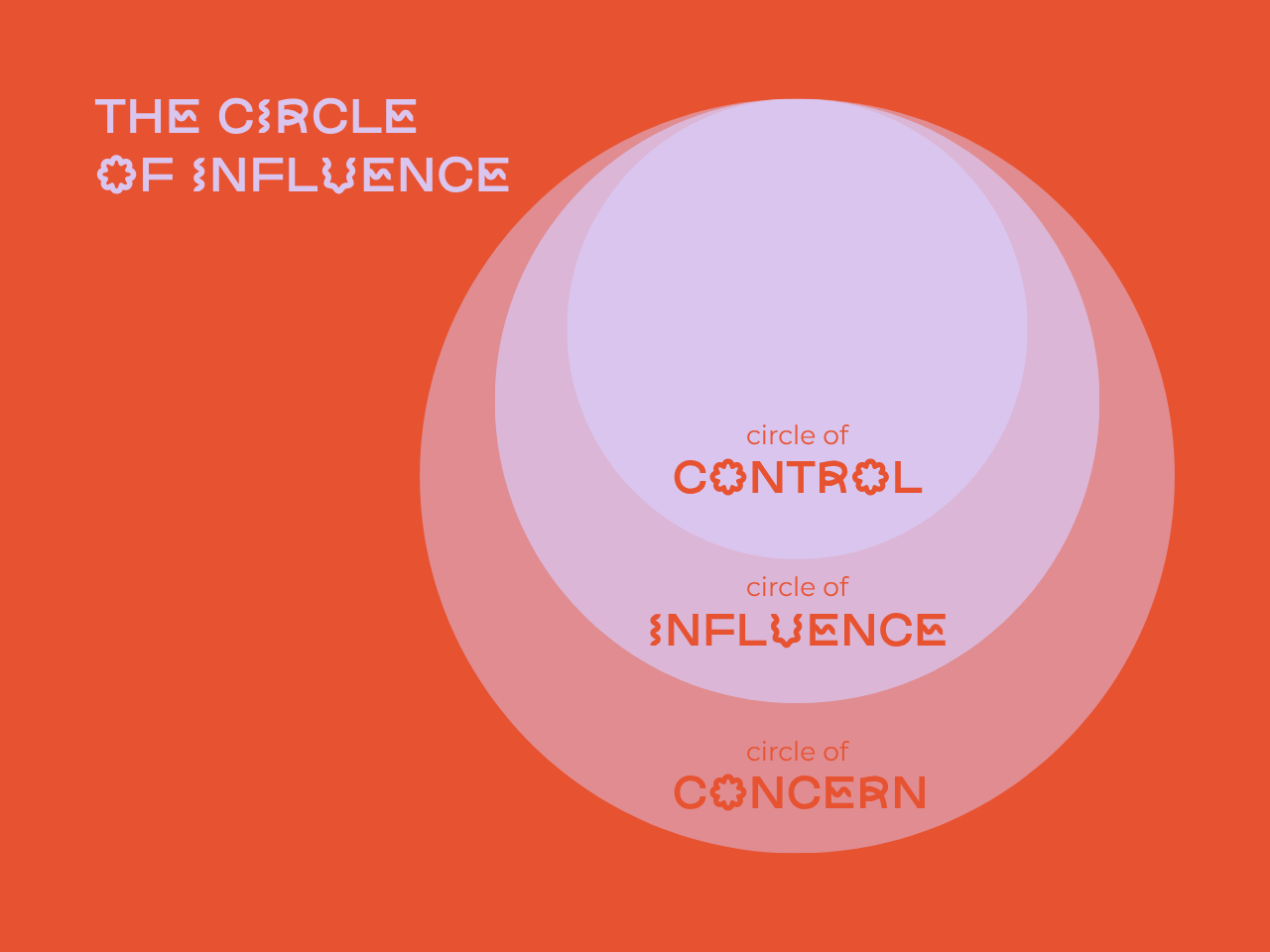
The inner circle is your circle of control.
These are the things fully within your power such as your actions, your boundaries, your reactions, how you prioritise your time.
The middle circle is your circle of influence.
These are things you don’t control completely, but you can affect - things like relationships at work, your workload over time, how you collaborate with your team.
The outer circle is your circle of concern.
Everything you care about but have basically no control over - think company strategy, the economy, your boss’s personality, other people’s behaviour, even the weather.
When we’re stressed, we tend to spend a lot of our mental energy in that outer circle.
Worrying. Replaying conversations. Imagining worst-case scenarios.
But the advice with this framework is simple:
Make changes in your circle of control.
Ask for what you need in your Circle of Influence.
Try not to burn your energy on the Circle of Concern.
If you’re reading this and feeling seen/exposed/attacked, there’s a good chance something inside those first two circles needs attention.
It could be a boundary, a conversation, or a change in how you’re working.
Or maybe the realisation that the environment you’re in isn’t the right one anymore.
So if Sunday Scaries feel familiar to you, maybe the question isn’t: How do I relax more on Sunday?
Maybe the better question is: What are these feelings trying to tell me about my work?
And once you know that: What’s one small thing inside your circles of control and influence you could experiment with this week?
Until next time,
Nat x
